Introduction
When people talk about 'manual scraping', they usually mean one of two things: manually copy-pasting data from websites, or writing custom scraping code in Python or JavaScript.
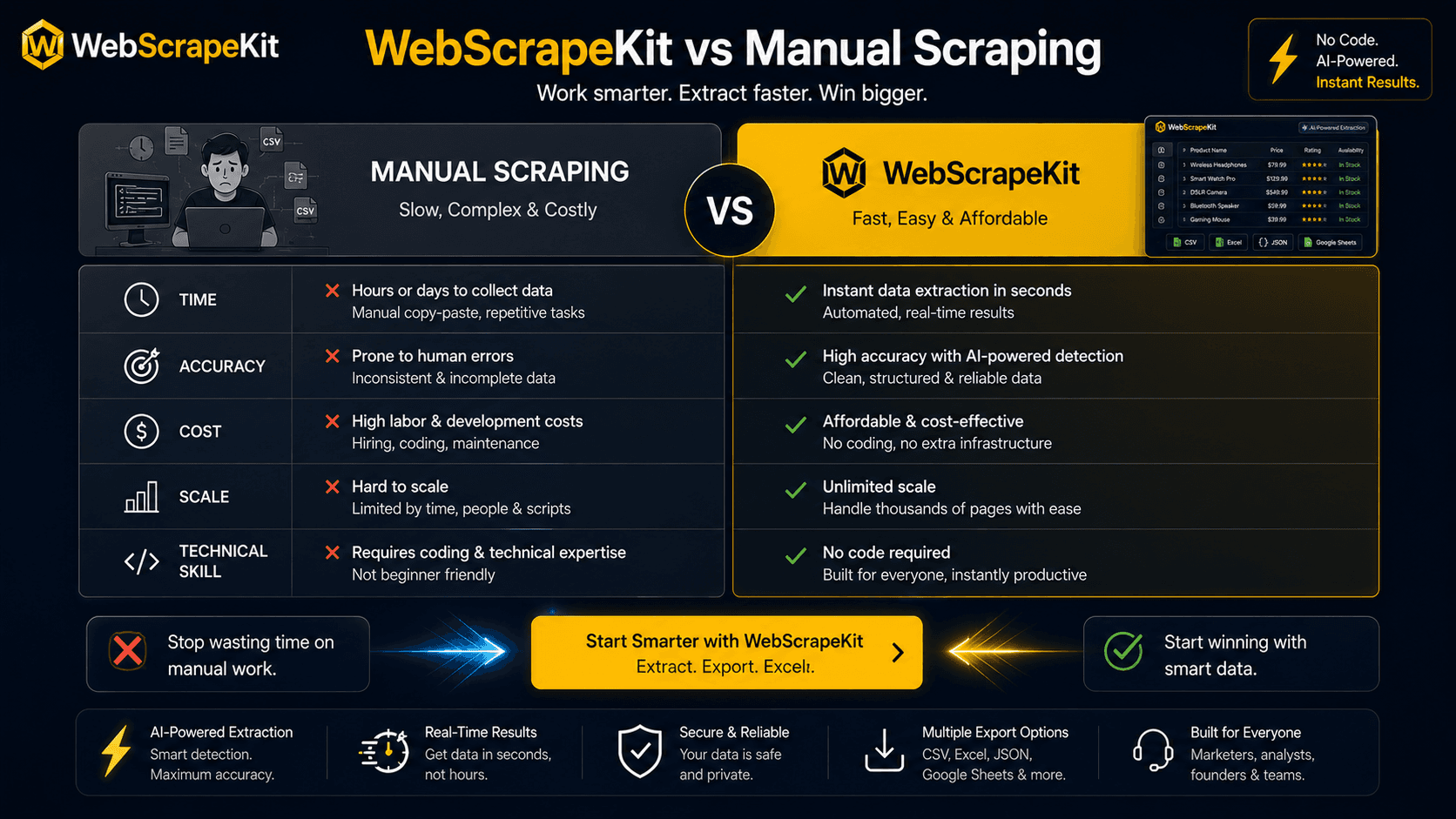
WebScrapeKit occupies a third category: automated browser-based extraction with no code required. But how does it actually compare to manual approaches on the metrics that matter?
This is a detailed, honest comparison across five key dimensions: efficiency, accuracy, cost, scalability, and accessibility.
Efficiency: How Fast Is Each Method?
Manual copy-paste: 60 to 80 data points per hour. For 500 rows, expect 6 to 8 hours of work.
Custom code scraping: 2 to 6 hours to write and debug the scraper, then seconds to run (but repeated for each new website structure).
WebScrapeKit: Setup time of 60 to 120 seconds per website. Extraction of hundreds of rows in under a minute.
Winner: WebScrapeKit for most use cases.
Accuracy: How Reliable Is Each Method?
Manual copy-paste: Human error rates of 1 to 4%. For 500 data points, that's 5 to 20 errors.
Custom code scraping: Near-zero error rate when correctly configured. However, when a website updates its structure, the scraper breaks silently.
WebScrapeKit: Near-zero error rate. The live preview feature lets you catch structural issues before exporting.
Winner: WebScrapeKit and custom code tie. WebScrapeKit has an advantage in usability due to the preview step.
Cost: What Does Each Method Actually Cost?
Manual copy-paste: At an average professional hourly rate of $30 to $50/hour, 8 hours of manual data collection costs $240 to $400 in labor.
Custom code scraping: Developer time at $50 to $150/hour to build, test, and maintain. Plus hosting costs if running scrapers on a server.
WebScrapeKit: Free. The core extraction features are completely free with no account required.
Winner: WebScrapeKit, by a significant margin.
Scalability and Accessibility
Scalability - Manual copy-paste does not scale. Custom code scales well once built but requires infrastructure. WebScrapeKit scales well for moderate volumes (hundreds to thousands of rows).
Accessibility - Manual copy-paste: anyone can do it, but time barrier is high. Custom code: requires technical skills, accessible to roughly 10 to 15 percent of professionals. WebScrapeKit: anyone with a Chrome browser, zero technical knowledge required, accessible to 100 percent of users.
Conclusion: The Honest Verdict
WebScrapeKit wins on efficiency, cost, and accessibility. It ties with custom code on accuracy. Custom code wins only at truly massive scale that most users never need.
For the vast majority of data collection tasks - competitive research, lead generation, market analysis, content audits - WebScrapeKit is the fastest, cheapest, and most accessible solution available.
Try the winner at WebScrapeKit.com